
Internal hackathons, design thinking, and employees’ skills
Beautiful things happen when a design thinking approach is applied to internal hackathons.
One of them is that participants gain new problem-solving skills.
The design thinking approach offers numerous methodologies for solving problems.
In this article, we explore the ones capable of enhancing the employees’ capabilities to deal with, manage, and decipher complex problems.
Table of contents
- The design thinking approach in hackathons
- Empathy: putting yourself in the user's shoes
- Creative problem-solving during hackathons
- The power of "5 whys."
- Divergent and convergent thinking
- Conclusions: The benefits of internal hackathons
At the heart of every successful internal hackathon is the application of the design thinking approach:
1. The design thinking approach in hackathons
Design thinking is a human-centred problem-solving methodology comprised of these 5 steps:
- Empathise
- Define
- Ideate
- Prototype
- Test
This approach encourages empathy, collaboration, and experimentation.
By incorporating it into your hackathon, you can empower your employees to tackle company problems head-on and develop innovative solutions.
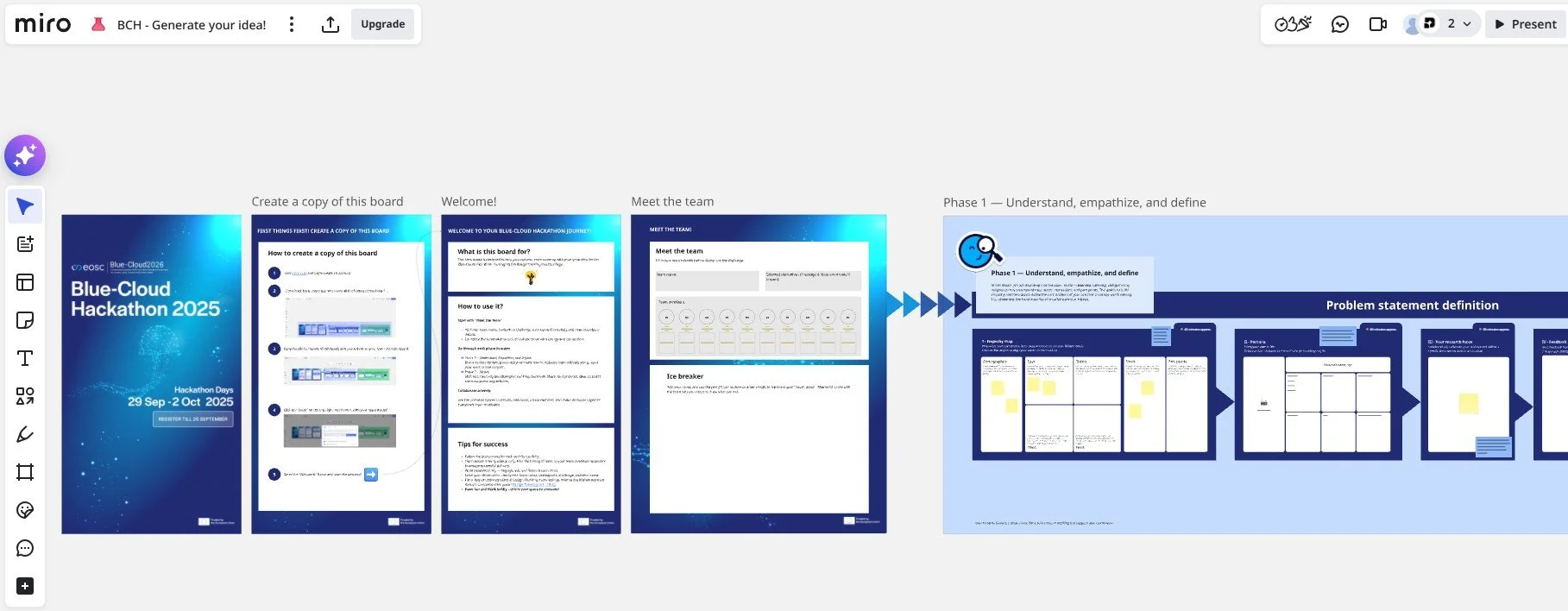
The employees will be guided on a journey that will start with the definition of the problem and will end with testing and validating a prototype, using consolidated methodologies and tools.
Below is a preview of how the process looks on Miro!
2. Empathy: putting yourself in the user's shoes
Empathy is not only one of our values here at Eventornado.
It’s also a critical component of design thinking.
By encouraging employees to empathise with end-users or customers, internal hackathons create a deeper understanding of their needs, pain points, and aspirations.
This empathetic approach helps teams develop solutions that truly resonate with users, enhancing the overall user experience and driving customer satisfaction.

3. Creative problem-solving during hackathons
During an internal hackathon, teams are accompanied by experts in a holistic process aiming to explore creative solutions to company challenges.
This guided-thinking environment encourages employees to step outside their comfort zones and come up with something truly new.
By leveraging diverse perspectives and skills, teams can approach problems from multiple angles, leading to fresh insights and breakthrough solutions.
4. The power of "5 whys."
One of our favourite design thinking techniques is called the “5 whys”.
To truly understand the root cause of a problem, it is essential to ask the right questions.
By repeatedly asking "why" at least five times, teams can peel back the layers and uncover the underlying issues.
This deep dive into the root cause enables employees to address the fundamental problem, rather than merely treating symptoms.

5. Divergent and convergent thinking
Design thinking encompasses both divergent and convergent thinking.
Divergent thinking encourages teams to generate a wide range of ideas and explore various possibilities.
This phase is the starting one, and it allows for free-flowing creativity and encourages outside-the-box thinking.
Convergent thinking, on the other hand, involves narrowing down ideas and making focused decisions.
Mentors and experts will guide employees on how to navigate both the divergent and convergent phases, so they can develop their ability to generate innovative ideas while ensuring practicality and feasibility during the hackathon.
6. Conclusions
Internal hackathons have a double impact:
The company will generate several ideas to solve several problems
The employees will receive training and therefore new skills
These events provide a safe space for employees to brainstorm and innovate, contributing to the company's growth.
By applying the design thinking approach, employees gain a deeper understanding of problems and can develop effective, user-centric solutions.
The utilisation of techniques like the "5 Whys" method helps employees identify the root cause of issues, leading to comprehensive solutions.
The divergent and convergent phases in design thinking foster broad idea generation and focused decision-making, enhancing problem-solving abilities.
Overall, hackathons are a fantastic brainstorming moment that drives innovation, solves complex problems, and stimulates growth within your organisation.
If you want to know more and understand how we could help you organize your hackathon, you can request a demo with our team today!

More articles by Eventornado



Are you looking to run a hackathon on Eventornado?
Request a demo, and we'll have you set-up in no time.
Request a Demo