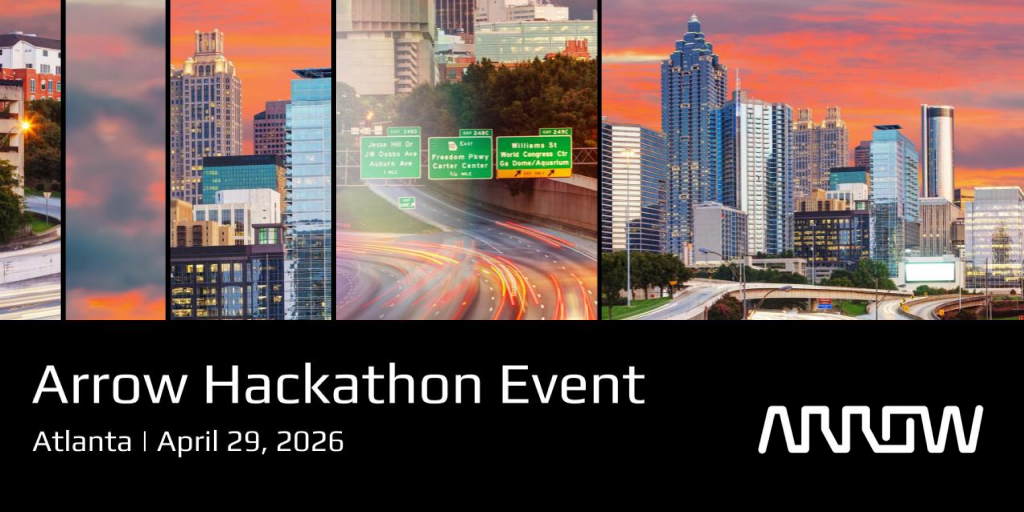

Hackathon use case: the Arrow Hackathon
The Arrow Hackathon, powered by Arrow Electronics, was a hands-on internal hackathon designed for technical sales and solution design professionals who work at the intersection of technology, architecture, and customer engagement.
Focused on “Secure the Modern Enterprise: Visibility, Identity, and AI-Aware Architectures,” this in-person internal hackathon challenged participants to translate complex enterprise requirements into scalable, multi-vendor solutions and to present them in the form of compelling executive-level pitches.
Rather than focusing purely on coding or prototypes, this internal hackathon emphasized presales excellence, solution architecture thinking, and the ability to communicate business value through technology.
Participants worked in a competitive, real-world simulation environment where architecture design, vendor positioning, and commercial storytelling were just as important as technical depth.
The internal hackathon was held in Atlanta (USA), bringing together enterprise IT professionals in a high-intensity, in-person innovation setting.
Table of contents
- What is the Arrow Hackathon?
- Who joined?
- Participation figures
- The challenges
- Hackathon timeline
- Conclusion
1. What is the Arrow Hackathon?
The Arrow Hackathon is an innovation and solution design challenge created to simulate real enterprise presales scenarios.
Participants are asked to design end-to-end, multi-vendor enterprise architectures that address modern security, cloud, and infrastructure challenges.
The goal is to mirror real customer engagements where solution architects and presales engineers must balance technical feasibility, business impact, and vendor positioning under time pressure.
In this edition, the focus was on building secure, identity-aware, and AI-ready enterprise architectures that help organizations modernize legacy environments while maintaining operational continuity and reducing risk.
The challenge reflected real market dynamics where enterprises must adopt Zero Trust principles, hybrid cloud resilience strategies, and AI governance frameworks without disruptive “rip-and-replace” transformations.
2. Who joined?
The Arrow Hackathon brought together Arrow employees, working in technical and customer-facing roles, including:
- 🛠️ Presales Engineers
- 🧠 Solutions Architects
- 🤝 Technical Account Managers
- 🚀 Engineering and Sales Leadership
- 🌐 Enterprise IT professionals involved in solution design and customer engagement
This mix ensured a strong balance between technical depth and commercial perspective, replicating real-world enterprise solution teams.
3. Participation figures
The Arrow Hackathon saw focused participation from enterprise technical professionals engaged in solution design challenges.
Here are the key figures from the event:
- 👥 Participants: 40 employees
- 🏁 Finalist teams: 4 teams
4. The challenges
Participants were tasked with solving three enterprise-grade architecture challenges focused on security, resilience, and operational visibility.
3 different challenges were envisioned:
Challenge 1 – Legacy network modernization
Participants were asked to transform a flat, legacy enterprise network into a secure, identity-aware architecture without replacing the entire infrastructure.
The scenario reflected a mid-market manufacturing company struggling with outdated firewalls, limited monitoring, and increasing exposure to AI-driven data risks.
Teams were required to design phased zero-trust transformation strategies that introduced identity-based access control, segmentation, and modern threat detection capabilities.
The goal was to modernize security incrementally while avoiding costly “rip-and-replace” approaches.
Key expectations included user identity visibility, AI usage control, network detection and response, and a clear phased migration strategy.
A strong solution demonstrated how identity becomes the new security perimeter while legacy infrastructure is progressively modernized.
Challenge 2 – Hybrid cloud chaos
This challenge focused on designing a resilient hybrid cloud architecture for a fast-growing SaaS company operating across on-premise and cloud environments.
The organization faced major challenges, including lack of backup strategy, limited observability, and increasing ransomware exposure.
Participants were expected to design scalable architectures that improve disaster recovery, observability, and security across hybrid and multi-cloud environments.
Key elements included immutable backups, microsegmentation, ransomware protection, and centralized visibility across workloads.
The goal was to eliminate downtime risks while enabling scalable and secure growth.
Strong solutions emphasized workload portability, automation, and consistent security policies across environments.
Challenge 3 – Healthcare security & IoT risk
The third challenge focused on securing a complex healthcare environment with thousands of IoT and unmanaged devices.
The scenario included medical devices, building systems, guest networks, and strict compliance requirements aligned with healthcare security frameworks.
Participants were required to design zero-trust architectures that ensure patient safety, data protection, and operational continuity.
Key requirements included IoT segmentation, identity-based access control, guest network governance, and full network visibility.
Successful solutions demonstrated how continuous verification and strict segmentation can protect critical healthcare systems without disrupting clinical workflows.
5. Hackathon timeline
The Arrow Hackathon took place in Atlanta (USA) with a fast-paced, single-day execution format.
Below is the full timeline:
| 🟢 Registration and team formation start — 24 April @ 09:00 (Atlanta time) |
| ⭕ Registrations and team formation close — 29 April @ 12:30 |
| 🏁 Hackathon introduction — 29 April @ 12:30 |
| 🛠️ Build Phase — 29 April @ 12:45 |
| 🗃️ Deliverable 1 // 5 slides presentation deadline — 29 April @ 15:00 |
| 🎤 Pitch Prep & 👨⚖️ 1st Round of evaluation — 29 April @ 15:00 |
| 🏁 Final presentations & 👨⚖️ 2nd Round of evaluation — 29 April @ 15:30 |
| 🎉 Winners announcement — 29 April @ 16:10 |
6. Conclusion
The Arrow Hackathon demonstrated how presales and solution architecture professionals can be challenged to think beyond traditional technical design and instead focus on business-driven enterprise transformation.
By simulating real customer scenarios, the event helped participants strengthen their ability to design secure, scalable, and AI-aware architectures while balancing technical constraints, commercial value, and vendor ecosystems.
Across legacy modernization, hybrid cloud resilience, and healthcare security, teams developed practical solutions that reflected current enterprise challenges such as Zero Trust adoption, ransomware protection, and AI governance.
The internal hackathon also highlighted the importance of communication and storytelling in technical sales, where success depends not only on architecture quality but also on the ability to clearly articulate business impact.
At Arrow Electronics, initiatives like this demonstrate how hands-on innovation formats can accelerate skill development across presales, architecture, and enterprise IT functions.
If you are planning a technical enablement program, presales challenge, or enterprise internal innovation hackathon, get in touch with our hackathon agency to design your next high-impact experience!




Are you looking to run a hackathon on Eventornado?
Request a demo, and we'll have you set-up in no time.
Request a Demo