
Online hackathon use case: the Blue-Cloud Hackathon 2025
In this use case article, we explore how we, as a hackathon agency, helped the Blue-Cloud 2026 project run the Blue-Cloud Hackathon 2025 through our hackathon planning, organization, and management services.
The Blue-Cloud Hackathon 2025 was a collaborative sprint for scientists, researchers, and innovators to dive into the open science ecosystem, organised by the Blue-Cloud 2026 project.
The hackers had the opportunity to experiment with marine data, design smart workflows, and harness the platform’s Virtual Labs, Workbenches, and analytical tools to generate new insights.
Through hands-on engagement, they explored the full potential of Blue-Cloud’s services, developed cutting-edge applications, and played a key role in shaping the platform’s next steps.
By addressing real-world user needs and surfacing areas for improvement, their contributions helped strengthen the Blue-Cloud ecosystem and propel collaborative, data-driven marine science forward.
Table of contents
- Benefits for participants: why people joined?
- Who joined?
- The stakeholders?
- What were the hackathon challenges to be solved?
- Challenge 1 - Mapping & Understanding Marine Ecosystems and Species
- Challenge 2 - Supporting Early Warning & Response to Accidents or Natural Events
- Challenge 3 - Tracking & Forecasting Ocean Health
- Challenge 4 - Wild Card: Double up with EDITO!
- Hackathon timeline
- Winning teams
- Prizes
- How Eventornado helped the Blue-Cloud team host the hackathon
- Kick-off
- Event engineering
- Website ready
- Platform ready
- Participants acquisition campaign
- Preparatory live sessions
- Hack days
- Project closure and final report
- Conclusion
1. Benefits for participants: why people joined?
The benefits of joining the Blue-Cloud Hackathon 2025:
- Boost your visibility among top organisations in marine science and ocean tech.
- Get inspired by pioneers and professionals tackling ocean sustainability challenges.
- Expand your network and collaborate across disciplines in a vibrant, cross-sector community.
- Play a direct role in shaping the future of Blue-Cloud by testing and improving its services.
- Compete for recognition — and open doors to potential follow-up support to advance your ideas.



2. Who joined?
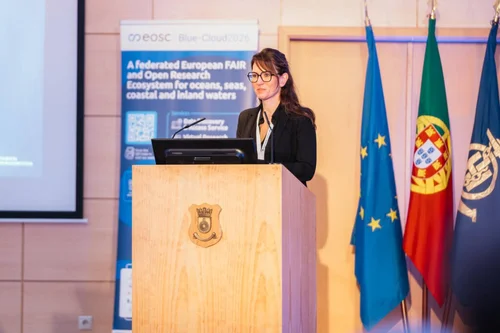
The hackathon welcomed multidisciplinary teams, with the most diverse skills and backgrounds, such as:
🌊 Marine scientists, data specialists, modellers, and researchers
📡 Providers of marine and environmental data services
🏭 SMEs and industry professionals in the Blue Economy
💻 ICT experts and developers working on environmental tech
🎓 Students, early-career professionals, and citizen scientists passionate about marine innovation
🌍 Public agencies, NGOs, and changemakers advancing ocean sustainability
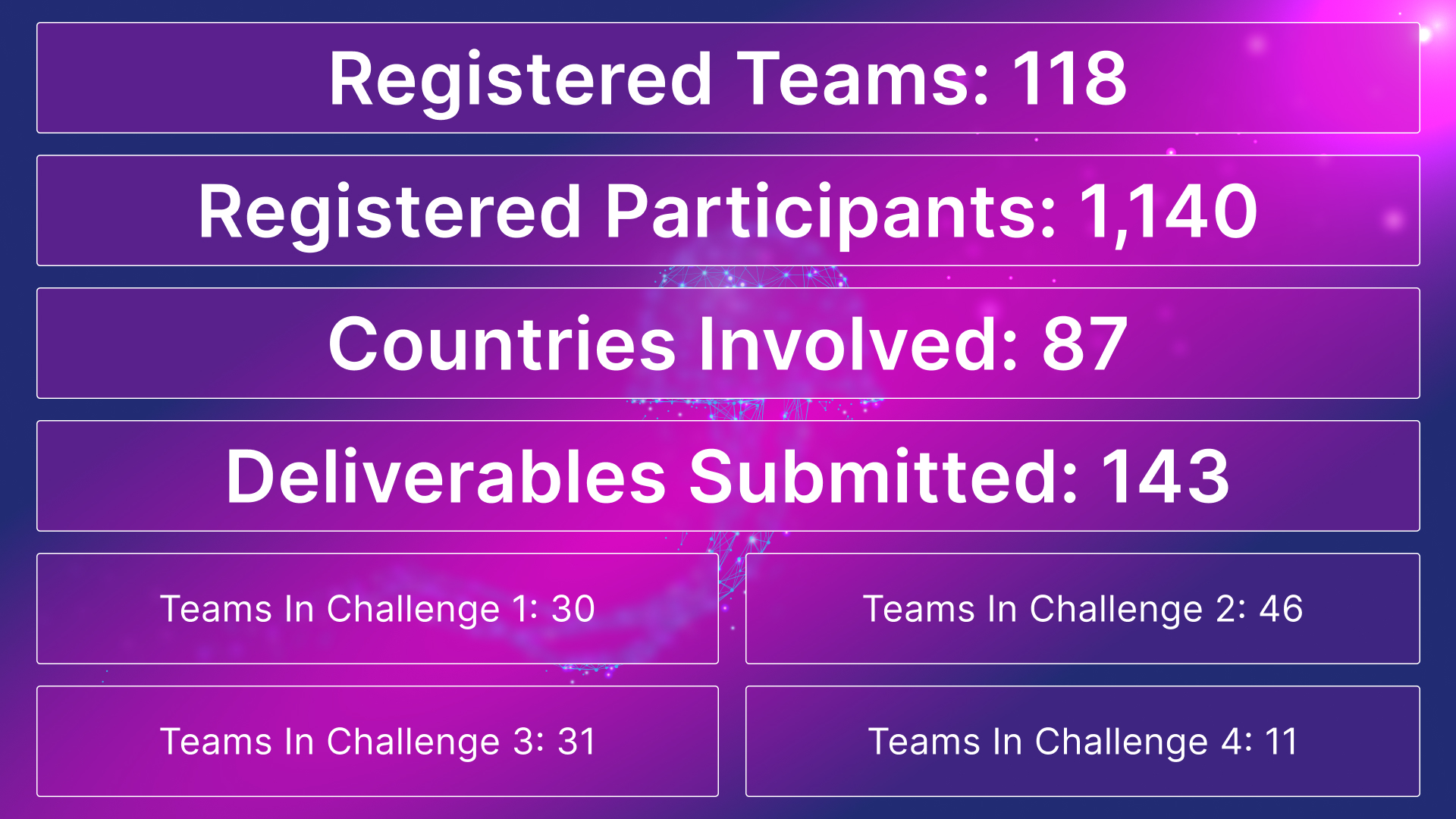
The Blue-Cloud Hackathon attracted an exceptionally high level of participation and engagement, making it a vibrant and highly active event: a true success.
Here are some numbers:
3. The stakeholders
The hackathon was co-organized by the Blue-Cloud 2026 project and was funded by the European Union.

Blue-Cloud 2026 & Hackathon partners








Blue-Cloud 2026 project is powered by open marine data & resources from


4. What were the hackathon challenges to be solved?
The hackathon invited participants to form teams and take on specific challenges related to pressing ocean issues.
These were the challenges to choose from:
4.1. Challenge 1 - Mapping & Understanding Marine Ecosystems and Species

How might we use collaborative science to advance the knowledge of marine ecosystems and species?
Marine ecosystems and their diverse species play a vital role in our lives. They regulate the Earth’s climate and are a primary source of food for billions of people. They support numerous economic activities and provide livelihoods for coastal communities around the world.
However, from plankton — the fabric of the ocean — to fisheries, our knowledge of species and ecosystems remains difficult to analyze with integrative approaches.
With your help, we can hack available data to address important knowledge gaps.
4.2. Challenge 2 - Supporting Early Warning & Response to Accidents or Natural Events

How might we use collaborative science to advance our ability to predict risks from natural events, or to ensure a swift response to accidents at sea?
Global change is affecting the way that species feed, move, and inhabit the marine realm.
Species migrations can have an impact on human livelihoods that rely on fisheries as a source of protein for human consumption. In addition, activities at sea carry risks to human life and wildlife.
With your help, we can evolve early warning mechanisms to anticipate a more effective response to global change.
4.3. Challenge 3 - Tracking & Forecasting Ocean Health
How might we use environmental indicators to understand complex phenomena affecting marine ecosystems and detect changes in their status with sufficient time to respond?
Climate change is causing severe impacts on marine ecosystems.
However, these changes are often difficult to anticipate, leading to delays in the implementation of actions that could mitigate risks and help us adapt to new conditions.
With your help, we can track and anticipate changes in the health of marine ecosystems to anticipate a more effective response.
4.4. Challenge 4 - Wild Card: Double up with EDITO!

How might we leverage the European Digital Twin Ocean platform to address Ocean challenges?
EDITO is the public backbone infrastructure of the European Digital Twin Ocean.
This wildcard invites you to address any Ocean challenge of your choice, harnessing the resources available in the EDITO platform in combination with resources offered by Blue-Cloud.
5. Hackathon timeline
Registrations and team formation open in May 2025, leading up to a warm-up ideation session in September.
Teams had to finalize their ideas by September 25, just in time for the hackathon kickoff on September 29.
All key deliverables (project summaries, presentations, and any supporting material) were due by October 1, along with a short video pitch.
Judging began right after, with final pitches and the winners announced on March 27!
This was the full timeline!
| 🟢 Registrations and team formation open - May 2025 |
| 🎙️Virtual warm-up starts! - 16 September @ 15:00 |
| 👏Virtual warm-up ends! - 25 September @ 15:00 |
| ❌ Registration and team formation close and💡Idea description submission - 26 September @ 12:00 |
| 🌊Hackathon starts - 29 September @ 10:00 |
| 📃 Deliverable 1 // Project Summary - 29 September @ 16:00 |
| 🗃️ Deliverable 2 // Presentation - 30 September @ 14:00 |
| 🔗Deliverable 3 ️[OPTIONAL] // Supporting evidence link - 30 September @ 18:00 |
| 🔖Deliverable 4 ️[OPTIONAL] - 1 October @ 11:00 |
| 📽️ Deliverable 5 // Video Pitch - 1 October @ 13:00 |
| 👩⚖️ Evaluation process starts - 1 October @ 13:01 |
| 🎉 Pitching and winners announcement! - 2 October @ 15:00 |
6. Winning teams
Out of the 118 teams, only 3 came out on top!
These are the best 3 ideas from the Blue-Cloud Hackathon 2025:
🥉3rd place
 Team name: TwinTrack
Idea name: DTO Meets Animal Movement: Mapping Marine Movements in the North Sea
Idea description: DTO-Track develops a Digital Twin prototype to connect ocean observation data with policy insights. For the Blue-Cloud Hackathon Challenge 4, the team integrates animal tracking data from the European Tracking Network with environmental datasets from the EDITO Data Lake and Blue-Cloud VRE. Using tracking data from species such as Atlantic cod, bluefin tuna, skates, and rays, the project models how marine animals may respond to offshore wind development and ocean warming. The prototype creates interactive “what-if” scenarios to support marine spatial planning and conservation, demonstrating how animal movement data can enhance Digital Twin systems for sustainable ocean governance.
🥈2nd place
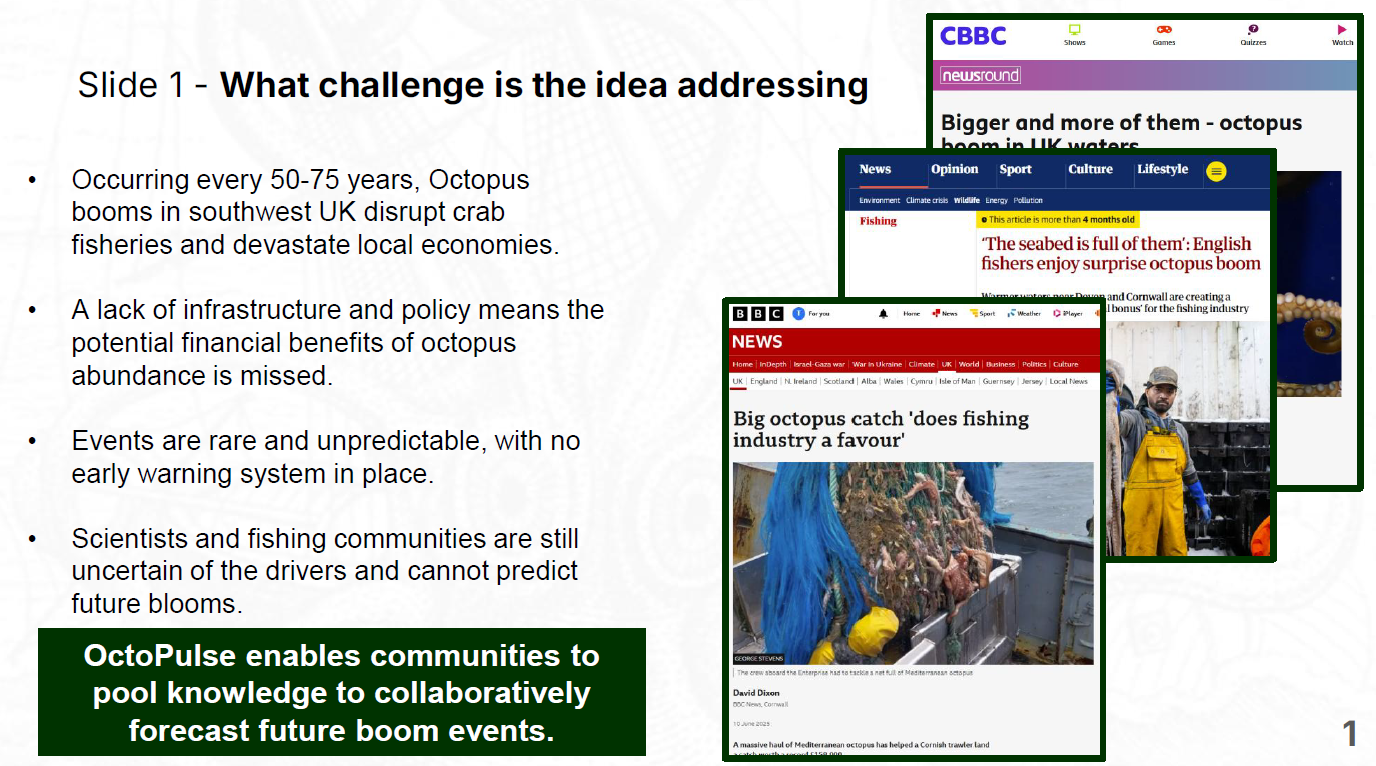 Team name: Kraken the code
Idea name: OctoPulse
Idea description:
OctoPulse investigates the periodic octopus population booms in South West UK waters, which can reduce crab catches by up to 80%. The project explores whether these events are linked to larval transport from continental Europe driven by ocean currents and weather conditions. Using historical datasets, meteorological records, and particle tracking models within the EDITO framework, the team will simulate larval drift and analyse environmental patterns during boom and non-boom years. The project will also develop interactive tools to help scientists, fishers, and managers explore the data and support adaptive fisheries management.
🥇1st place
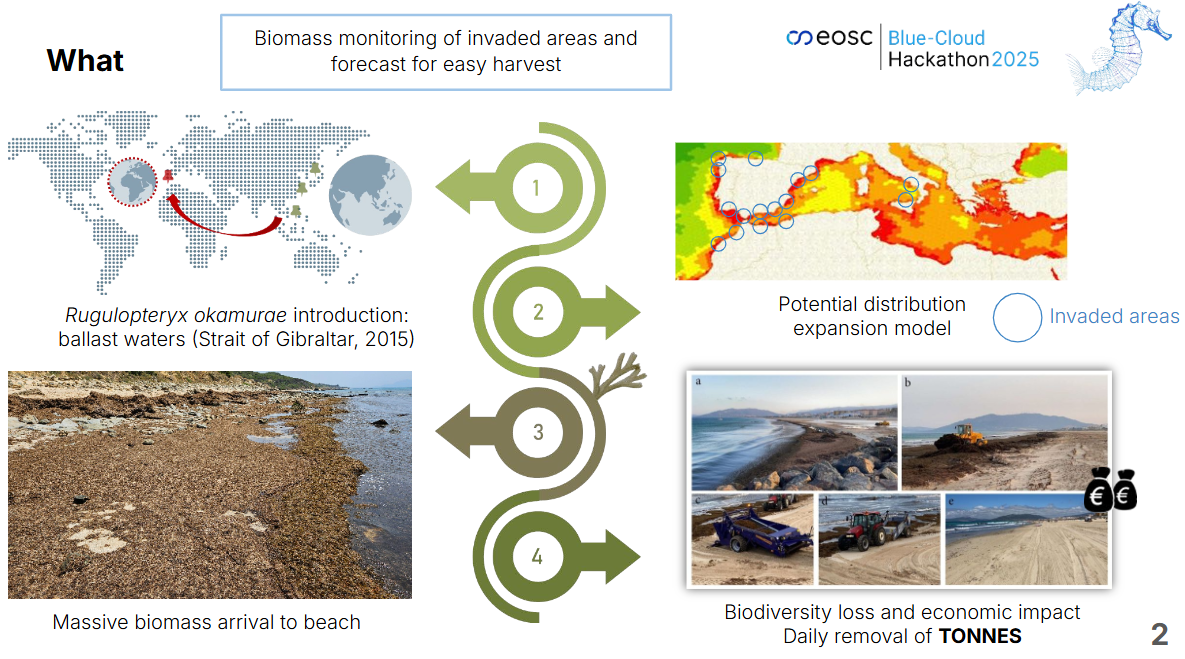 Team name: RugOBSS
Idea name: DTO Invasive Macroalgae Observing Beachcast System
Idea description:
DTO Invasive Macroalgae Observing Beachcast System addresses the growing impact of invasive seaweed, particularly Rugulopteryx okamurae, which has spread across European coasts since its first detection in 2015. The species generates large beachcast events that affect coastal ecosystems, tourism, and local economies. Using Sentinel-2 time series and oceanographic data, the project will develop a cloud-based remote sensing algorithm to quantify the biomass and frequency of these beaching events. The resulting observation system will support coastal decision-making, economic impact assessment, and explore opportunities to valorise the collected biomass (e.g., biogas or agriculture).
7. Prizes
TwinTrack, Kraken the code, and RugOBSS had the chance to pitch their ideas at the Blue-Cloud 2026 Final Conference & gain exclusive access to the EDITO platform!
They received €25,000 in total financial support to further develop and promote their solutions, with guidance from the Blue-Cloud project 2026.

8. How Eventornado helped the Blue-Cloud team to host the hackathon
As a hackathon agency, we took over the whole hackathon design engineering process, from the kick-off to the final event report, from the outreach campaign to the hackathon website design:
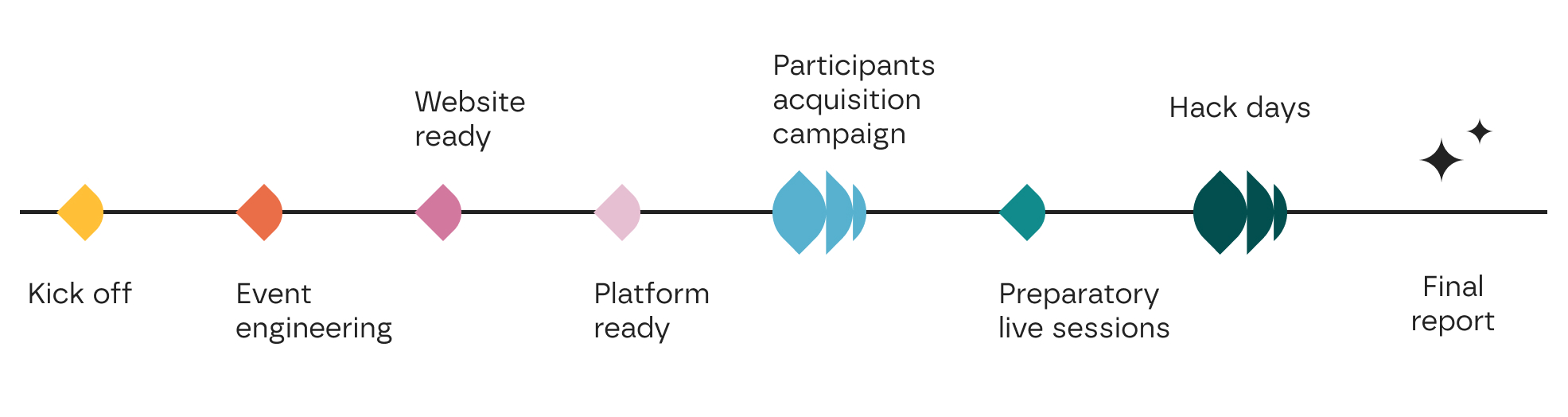
Let's explore each phase in detail:
 8.1. Kick-off
In this phase, we sat down with the Blue-Cloud team to gather as much information as possible about their goals and expectations for the hackathon, including the organization and results: number of participants and teams, tasks, GANTT, workflow, organizing team communication channels, and service levels.
This is one of the most crucial parts of running a hackathon, and it's also the moment when their problems become ours.
 8.2. Event engineering
Once all the information is gathered, we started designing all the planning hackathon activities.
What we did was create a collaborative, shared planning file that clearly explains each project phase, dependencies, task owners, and deadlines.
This document was dynamic and hosted on a shared drive to make sure everyone was always looking at the latest version of it.
During this phase, crucial aspects and processes of the event were defined, such as:
- Website content and graphic material
- Event's T&Cs
- Hack Guide and Resource Kit documents for participants
- Outreach campaign details, such as targeted audience, preferred channels, organic and paid campaigns
- Structure of the pre-event warm-up live sessions/webinars
- The mentoring process definition
- The evaluation criteria and methodology
…and much more!
 8.3. Website ready
Before opening the registrations, you need to have your hackathon website up and running, of course!
This phase was very “graphic design” focused and required a lot of involvement from our web and graphic designers.
It was an ongoing reiteration process, with feedback from the Blue-Cloud team and update actions from our side going back and forth to make sure we arrived together at the final version of the website, the perfect one.
If you're curious about this phase and want to know more about how to create a hackathon website, you can read this full guide on our blog!
Want to skip to the final result? Check out the Blue-Cloud Hackathon 2025 website here!
 8.4. Platform ready
Ok, so your website is ready to be launched.
It's now time to prepare the hackathon platform.
That's the place where participants will actually register, form teams, and participate in the hackathon.
What needs to be done in this phase is to:
- Create the registration form
- Finalize the team's form (where they will submit their ideas)
- Generate the event timeline
- Prepare the chat welcome messages on the chat system (Discord, in this case 😉)
- Publish all the info tabs, such as Mentors, Jury, Live Sessions, Hack Guide, Tutorials, etc
…and many more important things like managing the settings for the matchmaking feature for the teams to easily find/join/complete their teams, set the privacy settings, and connect the analytics tools such as GA4 and Meta Pixels to track the outreach campaign results.
 8.5. Participants acquisition campaign
We're now finally ready to launch the campaign and attract participants to the hackathon.
As we say: no participants, no event.
So this is maybe the most important phase in a hackathon.
For the Blue-Cloud Hackathon, we adopted our holistic approach: we leveraged all the relevant, most suitable channels, from organic to paid, from reaching out to communities to direct emailing, and much more.
In particular, the paid campaign entailed the following crucial phase:
- Select the campaign channels to be leveraged (LinkedIn, Meta, Reddit, etc.)
- Define the targeted audience
- Design the ad banners and graphic materials
- Write the ad copy
- Install and connect the LinkedIn Insight Tag, Meta Pixel, and Reddit Insight tag to the website and to Eventornado
- Get your ads approved by social media (sounds easy, but trust us, it's not)
- Run A/B tests and keep monitoring the ads
- Get people registered!
We tried to simplify the description of this process as much as possible, but the truth is that running an outreach campaign for a hackathon requires experience, skills, knowledge, and sometimes a little patience.
If you don't know what you're doing, it can be really stressful.
But hard work always pays off.
And it did for this event 😍
 8.6. Preparatory live sessions
These pre-event warm-up webinars are hosted to provide the participants with all the information they need to participate in the hackathon.
For example:
- Introduction to the hackathon and its goals
- Details about the tools made available for the Blue-Cloud Consortium
- Instructions on how to use Eventornado, form a team, communicate with mentors, and submit the deliverables
- Official hackathon kick-off
For this phase, Blue-Cloud brought the speakers and experts, and we provided all the infrastructure to host the event, including video recording and editing for a YouTube upload.
Below, you can rewatch the Kick-off!
The Blue-Cloud Hackathon Kick Off!
 8.7. Hack days
And here we are, D-Day has come.
After weeks of preparation, outreach, and warm-up sessions, the Blue-Cloud Hackathon was officially launched.
This is the moment when participants finally start working on their ideas, building prototypes, exploring datasets, and collaborating with their teammates.
During the hack days, our role shifted from preparation to active event management and support.
Behind the scenes, the Eventornado team continuously monitored the platform and communication channels to ensure everything ran smoothly and that participants had the best possible experience.
In particular, this phase involved:
- Monitoring the Eventornado platform to ensure registrations, team formation, and submissions worked flawlessly
- Supporting participants through the #general and #support Discord channels
- Coordinating mentors and facilitating mentor–team interactions
- Sending reminders for the deliverables deadline
- Troubleshooting and solving technical issues when they appeared (because they always do!)
One of the key aspects of a successful hackathon is maintaining momentum and engagement throughout the event.
To achieve this, we kept the community active through reminders, announcements, and live interactions, helping teams stay focused and motivated until the final submission deadline.
Not too many! Just the right amount 😉
Meanwhile, participants were busy:
- Exploring the Blue-Cloud services and datasets
- Developing their ideas and prototypes
- Preparing their final deliverables and pitches for the jury
The event concluded with the Final Pitching & Award Ceremony, where we provided moderation and technical support for each phase on Zoom!
 8.8. Project closure and final report
Once the Blue-Cloud Hackathon concluded, the final phase focused on wrapping up the project and documenting the results!
We compiled a comprehensive final report summarizing the key outcomes of the event, including participation statistics, teams and submitted projects, outreach campaign performance, live session engagement, evaluation results, and overall impact.
This report provided the Blue-Cloud team with a clear overview of the event’s performance and valuable insights for future initiatives.
At the same time, participants received official certificates of participation to recognize their contribution to the hackathon and their work on advancing data-driven solutions for ocean science.
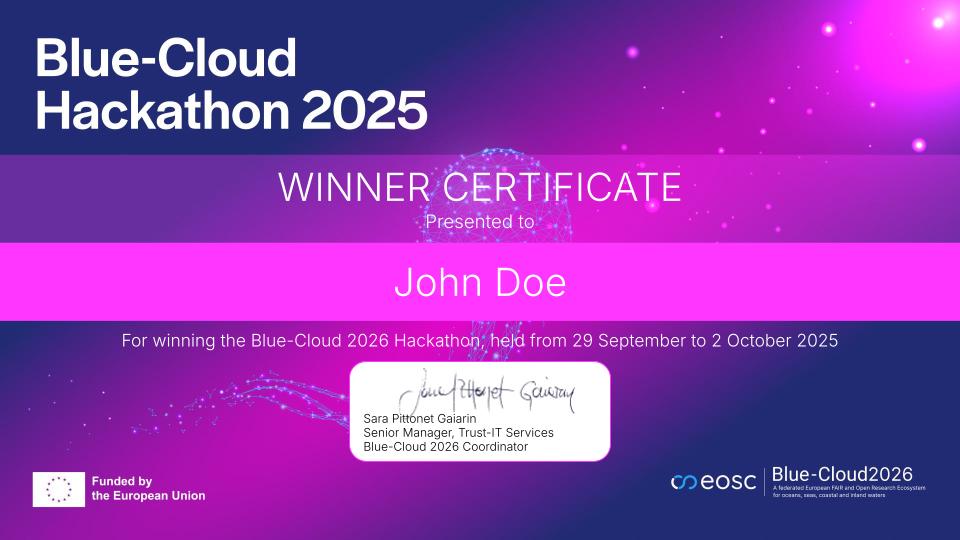
With the report delivered and the certificates issued, the Blue-Cloud Hackathon 2025 officially came to a close, leaving behind new ideas, innovative projects, and a stronger community around open ocean science! 🌊
9. Conclusion
The Blue-Cloud Hackathon 2025 showed how open science and collaboration can turn marine data into real solutions for ocean challenges.
Across four challenges, participants built prototypes for ecosystem modelling, early warning, Digital Twins, and ocean monitoring.
The event also strengthened collaboration across research, industry, and public stakeholders, while generating feedback to improve the Blue-Cloud platform.
At Eventornado, we handled the event end-to-end with our hackathon agency services: from design and setup to participant onboarding, team formation, live event management, and final reporting.
Acting as the central coordination layer, the Eventornado hackathon platform ensured smooth operations, strong engagement, and seamless collaboration across all stakeholders, allowing organizers to focus on impact while we took care of execution.
Get in touch today if you need help organising your hackathon!
Request a demo with our team today!



Are you looking to run a hackathon on Eventornado?
Request a demo, and we'll have you set-up in no time.
Request a Demo